ORBITALIS FIELD GUIDE
One small rock. Twenty ways to grow.
ORBITALIS is a free, single-player survival game about finding your next safe meal in a moving cosmic field. Begin as a Stardust Shard, absorb bodies with less mass, and work toward the twentieth form: a Black Hole. You can play with a keyboard, mouse, or touch, without an account or download.
01 / YOUR FIRST RUN
Steer, absorb, survive.
Wait for the opening field to load, then choose Play · Become a Black Hole. The first-run guide points out a safe target. Move close enough to absorb it automatically; there is no attack button.
Mass decides the outcome. Before the final form, a body is edible only when its mass is lower than yours. Equal or heavier bodies are threats. Watch the radar's edible and threat markers, and give danger space before you commit to a turn.
The mass readout tracks your growth. The evolution meter shows progress toward the next form. Absorbing enough material changes your body and opens up a larger-scale field.
- Keyboard
- Hold WASD or the arrow keys to thrust in that direction.
- Mouse or touch
- Press and drag inside the game field. Drag farther from where you pressed for stronger thrust. Release to stop applying thrust.
- Pause
- Press P or use the pause button. Choose Resume Run to continue; starting a new run resets the current one.
- Sound
- Use the audio control to mute or unmute. Sound is optional and starts after you interact with the game.
02 / READ THE FIELD
A safe route beats a risky shortcut.
Take the nearby small bodies first.
A cluster of edible bodies gives you several chances to grow without crossing the entire field. Check the route as well as the target: an edible body beside a threat may be a poor trade.
Turn before you reach the danger.
Your body has momentum and keeps drifting when you release the controls. Begin steering away early. On touch, a short drag gives you finer control than pushing the stick all the way out.
Recheck the field after evolving.
Your mass and the surrounding scale change as you advance. Look at the radar and next-form meter again instead of chasing the same route by habit. Growth makes more bodies edible, but it does not make every encounter safe.
Keep the chain in perspective.
The Chain Reaction counter celebrates quick consecutive absorptions. It is not a mass multiplier. Let a chain end if keeping it would mean cutting across a heavier body's path.
03 / IN THE GAME
From pebble to event horizon.
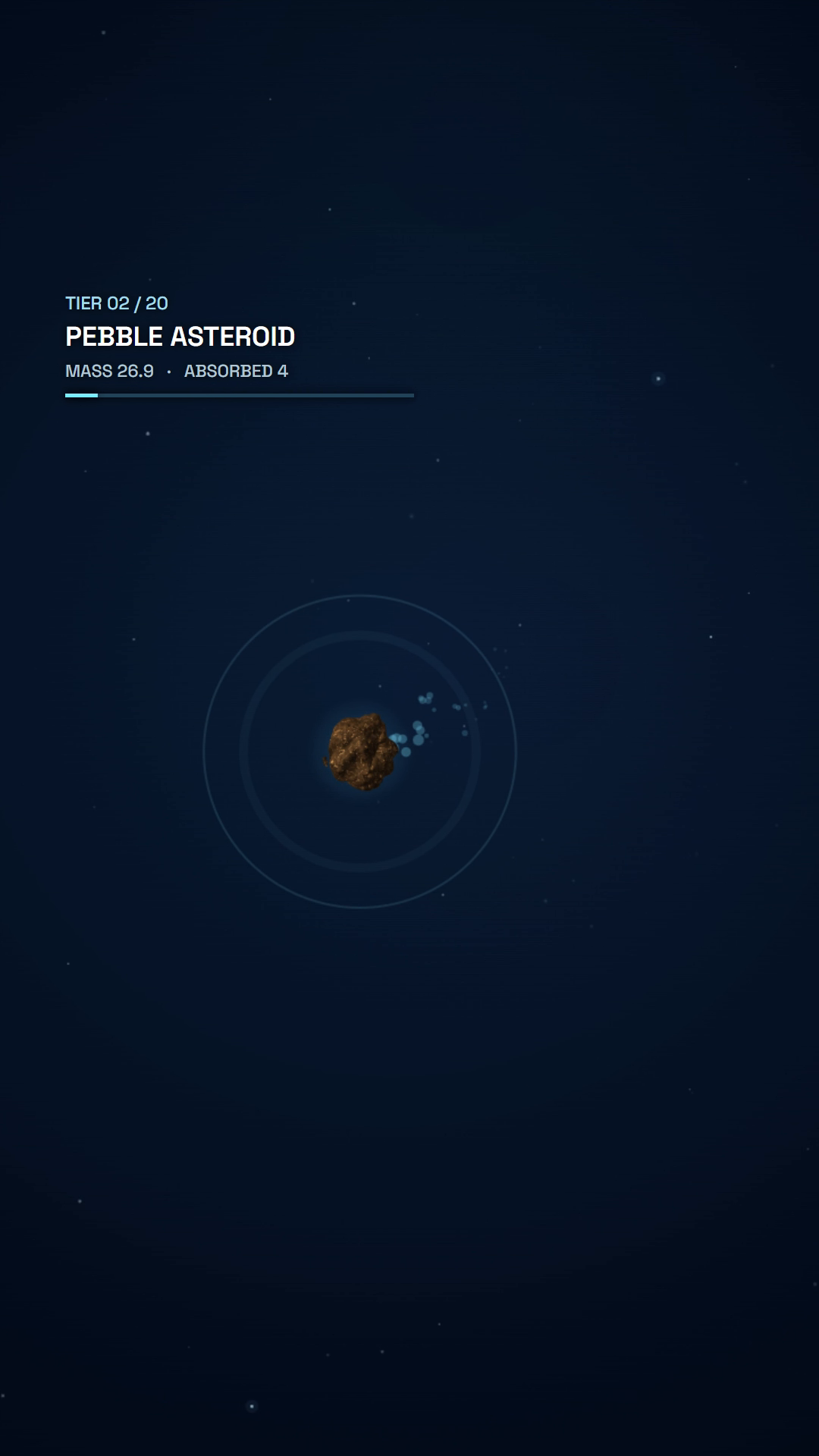
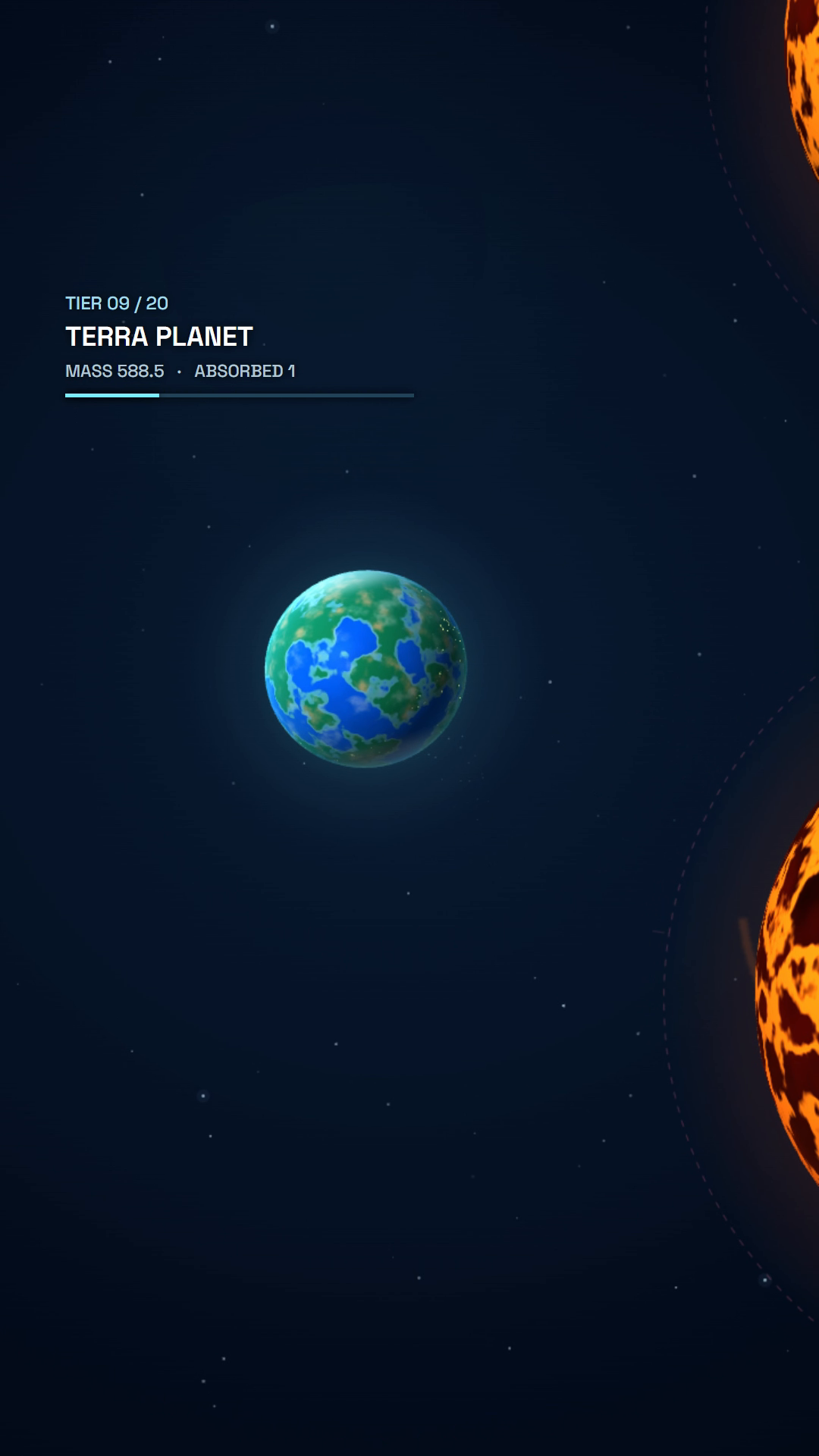
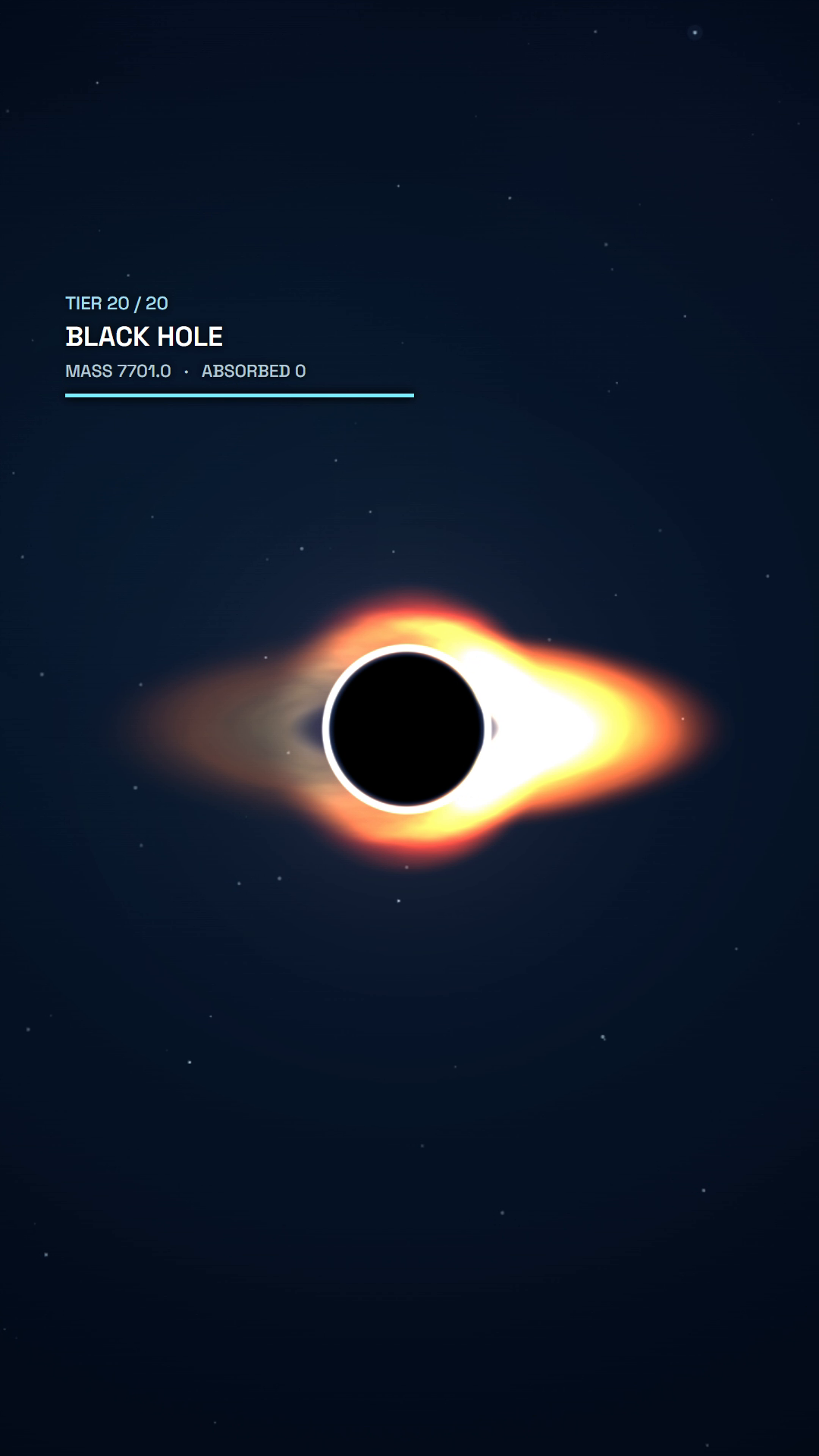
Frames from recorded ORBITALIS gameplay, with the recording's compact readout. These show separate stages; they are not a single uninterrupted run.
04 / THE EVOLUTION PATH
Twenty forms, one continuous run.
The opening stages take you from dust through asteroids and moons. Planets and gas giants follow, then stellar forms and the final Black Hole. The values below are in-game mass milestones, not real astronomical measurements. This is a space-inspired arcade progression, not a model of how a real planet becomes a star.
01–06Dust, rock and moons
07–13Planets and gas giants
14–19Stars and remnants
20The Black Hole
See all 20 forms and their mass milestones
| Tier | Form | Mass needed |
|---|---|---|
| 01 | Stardust Shard | Starting form |
| 02 | Pebble Asteroid | 24 |
| 03 | Iron Asteroid | 55 |
| 04 | Molten Planetesimal | 95 |
| 05 | Proto Moon | 145 |
| 06 | Lunar World | 210 |
| 07 | Dwarf Planet | 295 |
| 08 | Ocean Planet | 400 |
| 09 | Terra Planet | 540 |
| 10 | Volcanic Super-Earth | 720 |
| 11 | Mini Neptune | 950 |
| 12 | Gas Giant | 1,240 |
| 13 | Ringed Giant | 1,600 |
| 14 | Brown Dwarf | 2,050 |
| 15 | Protostar | 2,600 |
| 16 | Main Sequence Star | 3,250 |
| 17 | Red Giant | 4,050 |
| 18 | White Dwarf | 5,050 |
| 19 | Neutron Star | 6,250 |
| 20 | Black Hole | 7,700 |
Reaching the Black Hole completes the journey and shows your run time, mass and absorbed total. You can start again, share the result, or continue in endless mode. In this final form, the usual lower-mass restriction is lifted.
05 / BEFORE YOU PLAY
Good to know.
- Why did I lose to something that looked similar in size?
- The rule compares mass, not just the apparent size of the artwork. Before the Black Hole form, equal mass is a threat too. Use the radar and warning cues when deciding which body to approach.
- Is this multiplayer?
- No. Each run happens in your browser. Challenge links share a tier and mass for friendly comparisons; they are not server-verified leaderboard scores.
- Can I save a run and return later?
- Pause keeps the current run available while the page stays open. Leaving or reloading the page ends it. Your best result and preferences are saved on this device, so another browser or device has its own records.
- What if the game does not load?
- The game needs JavaScript and WebGL in a current browser. Allow the initial assets to finish loading. If the field stays blank, reload once, check that graphics acceleration is available, or try another browser. This guide and the About page remain readable without starting the game.
- Do I need to pay or allow analytics?
- No payment or account is required. Analytics is optional; declining it does not prevent you from playing. The privacy notice explains local saves and optional measurement.